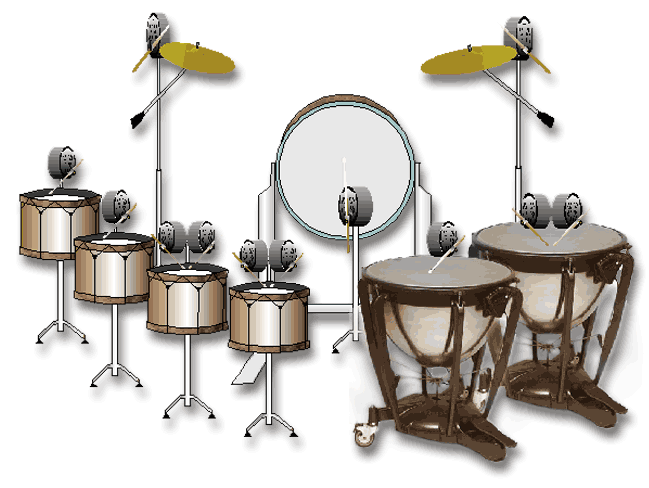
A complete drum: a bass drum, four snare-drums, two timpani and two cymbals, played by sticks in complete autonomy.
A drum automat by extent, whose partitions are programmed on computer.
D E S C R I P T I O N
“BAM”
A complete drum: a bass drum, four snare-drums, two timpani and two cymbals, played by
sticks in complete
autonomy.
A drum automat by extent, whose partitions are programmed on computer.
"Summer 1994, Olivier Tarabo invents an electromagnetic process allowing to actuate rods of percussion in a so precise way which it reproduces with only one" hand "a drum roll of a level of academy! The system is Midi, (programmable by computer) what allows programming of the partitions of play as simple as for drum-machine. The sticks have different forces level what gives them the groove of a realistic play.
BAM, like Acoustic Battery Midi, is currently made up of eight barrels, two cymbals, thirteen
sticks (two sticks on each barrel sometimes proved to be useless!) and of a fly-case of 9 units. Well on, the system could reach an unlimited number of barrels, it is a question of proportions to (or not) keeping
'Sono Magazine' 2000
Principle of operation:
Recording:
Any programs of Midi editing, like Cubase in this example, exactly as for
drum machine, by choosing a note
midi for a stick.
A played drum with two rods will be seen for example allotted two notes: C3 and C#3 for the
sticks left and right-hand
side.
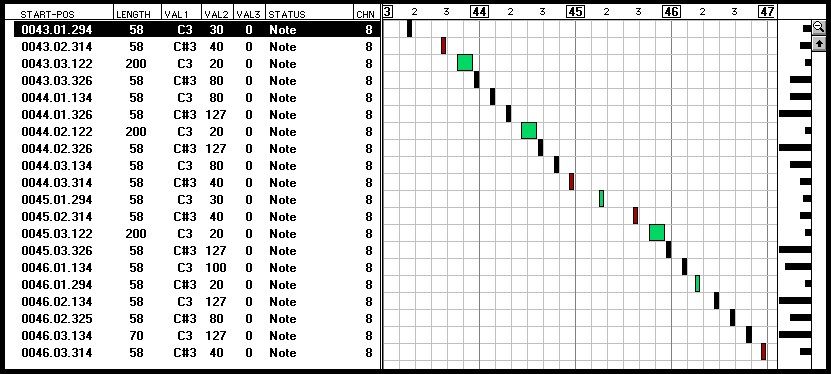
One will publish the partition on the table of programming of the software
midi:
Start Pos: the blow of sticks placed in the tempo
Lenght : duration of the impulse, useful to obtain a short blow or a bearing (see low)
Val 1 : the note, therefore the stick chosen, here two sticks of the C3 drum and C#3
Val 2: the deterrent force, programmable from 0 to 127, which will give us a strong blow, average or weak
Data processing midi :
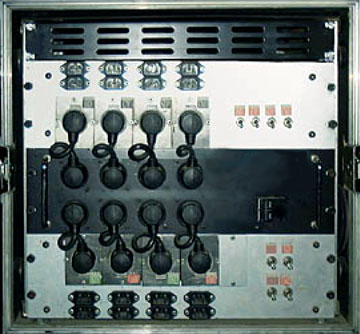
The "brain" of the BAM transforms the programming
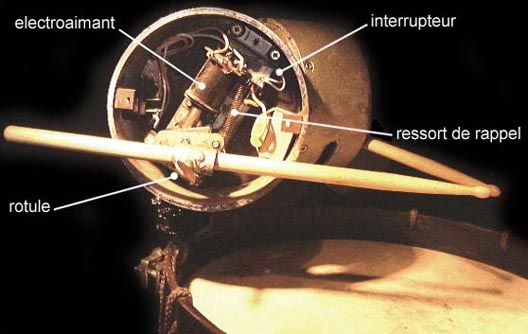
midi into pulses from 0 to 24 volts (according to Vallue 2) and feeds from the electromagnets connected to the
sticks.
Correction of the mechanical delay:
According to the intensity of the deterrent force, a more or less significant delay occurs fatally. This delay is due to the variable electric output which the electromagnet receives which
"will goes down" the stick more or less quickly.
It is thus necessary to make up for this mechanical lost time to find the blow places from there on the
rate/rhythm.
The solution consists in sending the order of striking before the real time, in other words to precede the
events.
A curve of delay was calculated indicating time to withdraw before each blow according to each tempo and each intensity.
For these calculations, measures were taken with an oscilloscope by comparing the direct theoretical signal and a real blow on the
barrel.
These measurements were taken on a maximum of key points, with deterrent forces and different tempos.
A curve logarithmic curve was drawn for all intermediate
measurements.
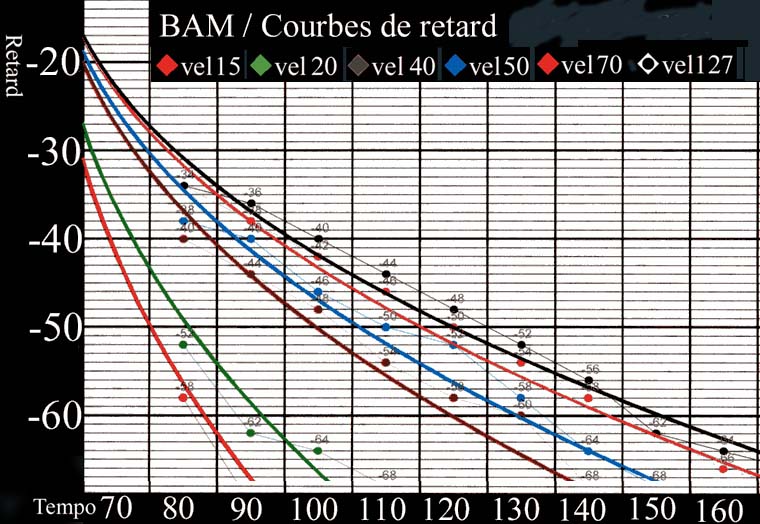
One will read for example that with a tempo of 75 and for a swiftness of value 20 (in green on the curve) the delay to be caught up with is of 43ms.
It would be hard to correct all these data with for each blow of a composition, also one will employ a script to correct these values in only one operation:
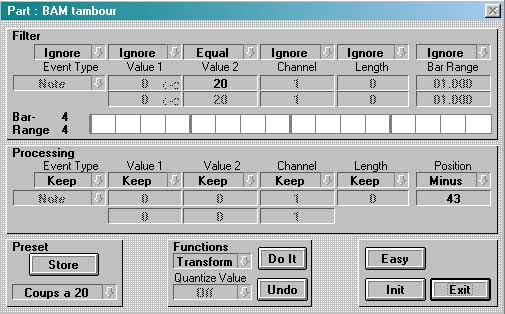
This script requires here: for all that with a value 20 in swiftness, to withdraw 43 from the position.
The shift of the mechanical delay is thus caught up with.
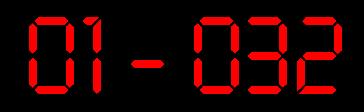
The Counter of tempo:
On stage, to facilitate the play of the musicians, a
Counter ravels in syncronisation with the BAM.
This tool is essential for a composition with a long introduction for example to the guitar
solo and a drum which would begin its play with the 32th measure…
Rolls?
According to the duration of the pulse and thanks to the rebound of the skin, the BAM plays the
rolls.
It is easy while insisting over the length of the impulse to program ruffle of 3 of 5 of 9, or
continuous rolls…